
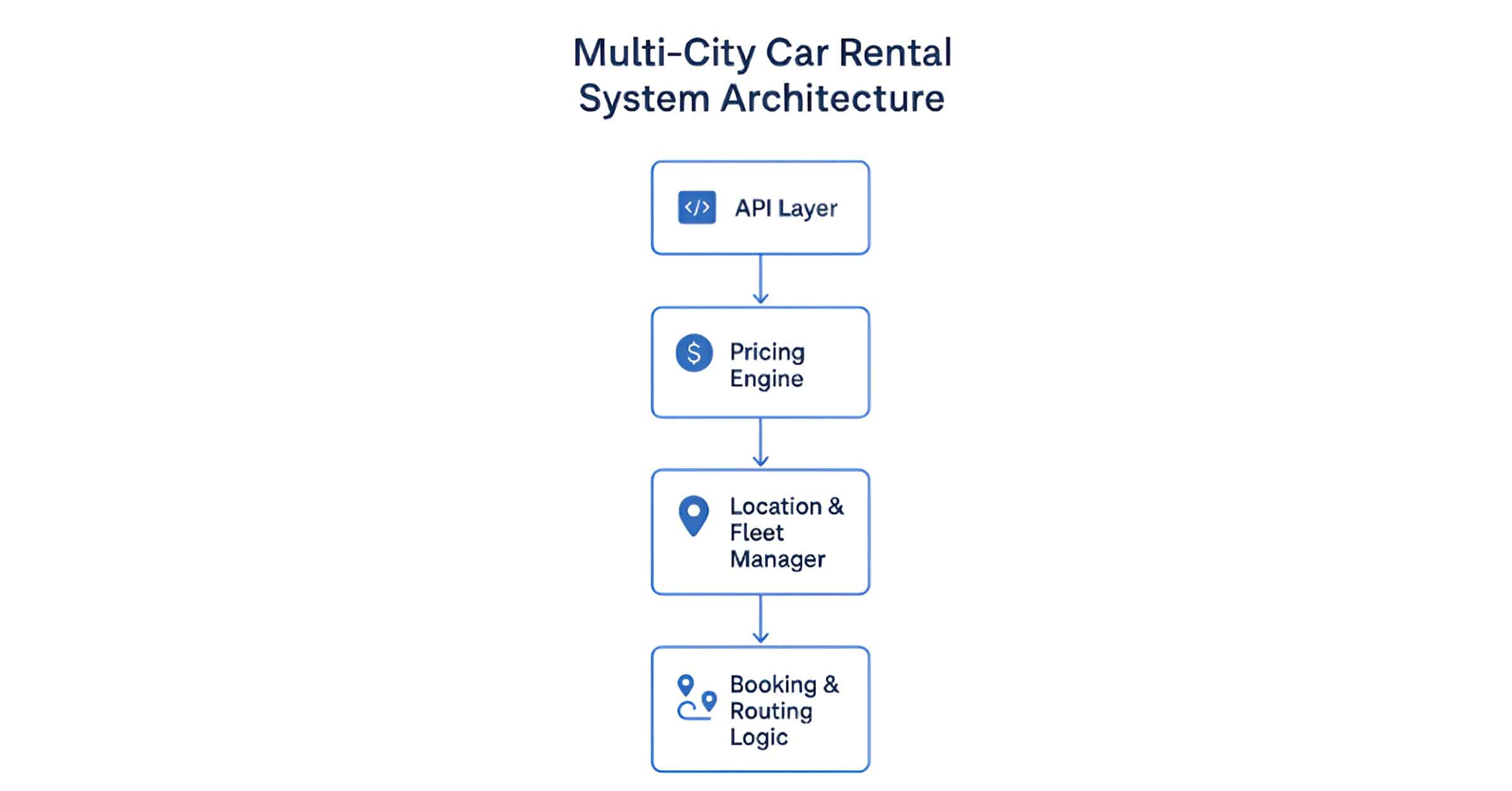
Creating a multi-city car rental platform is a logical extension of a single-city platform, but once you introduce multiple locations, the entire architecture changes. The flow in paper is straightforward – search, select, book.
As a matter of fact, when you grow, things become much more complicated. Each new city has its own pricing policies, fleet supply peculiarities, API interaction, and user anticipations. The system may easily get out of control and become confusing to users without proper planning.
At Kbizsoft, we have done both simple and complex travel and mobility platforms, such as hotel booking integration with Ratehawk API and car rental shops. These projects have provided us with exclusive knowledge of the obstacles that developers encounter during the development of multi-city platforms.
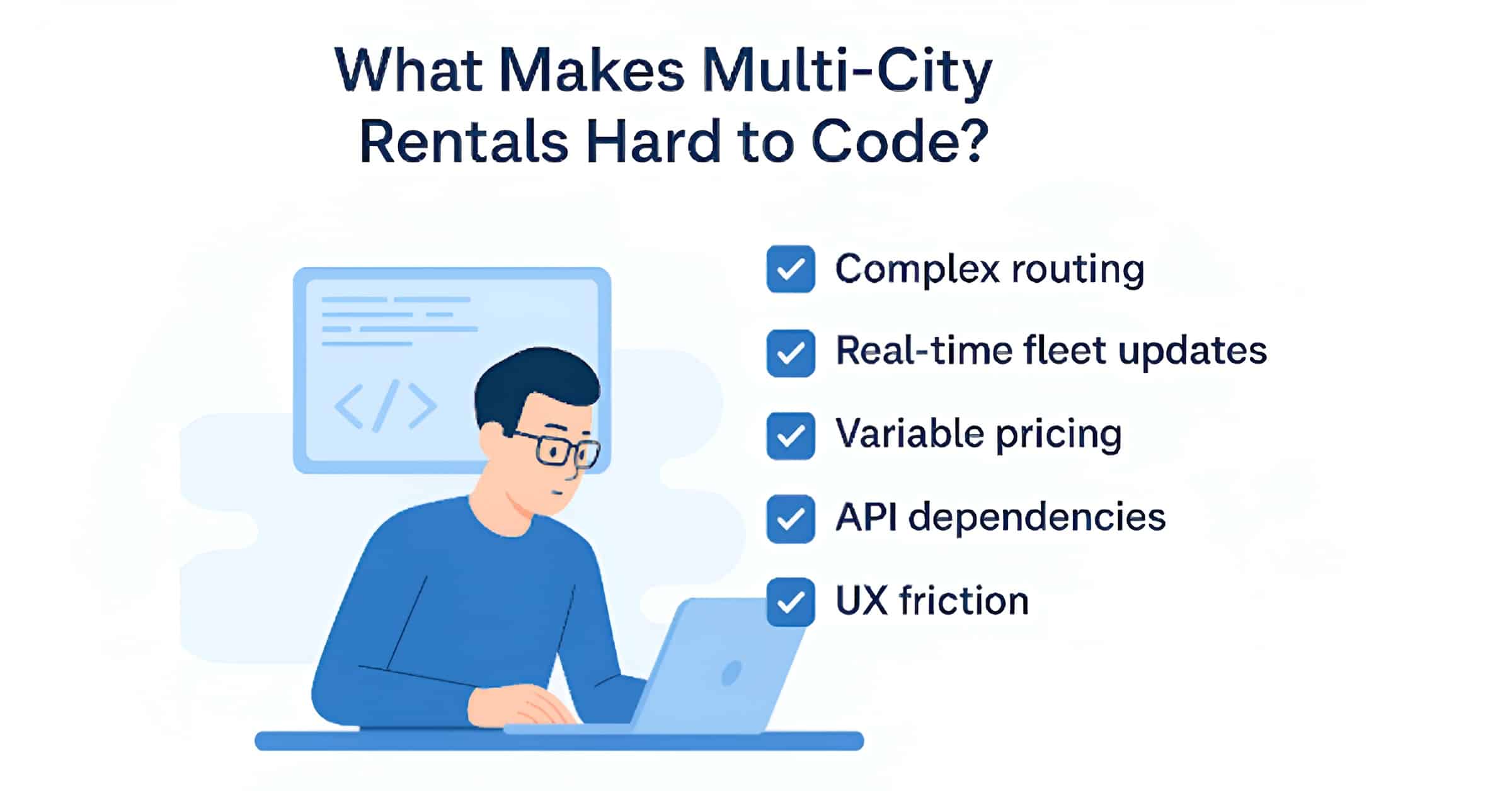
Let’s give a detailed look at the five largest challenges and how they can be overcome in an efficient way.
1. The Dynamic Pricing Model
Pricing is one of the first and most inevitable problems. Each city obtains its taxation system, a surcharge, seasonal pricing trends, insurance, and the particular vendor’s rules. A pricing engine that is operational in Mumbai can entirely melt down in Jaipur or Dubai.
The challenge is to develop a model that would be flexible to fit every city and not to create chaos in the back-end. Pricing laws that are hardcoded are nightmares to maintain. Cities expand, sellers evolve, and new pricing regulations emerge out of the blue.
The best solution is to develop pricing in blocks that can be configured. Every city is expected to have its own rules set which is updated locally. With the proper approach, the addition of a new city is such an easy, predictable one instead of an entire restructuring.
Connect With Us Today
2. Live Availability That Really Remains Accurate
Users will put their confidence in the rental sites as long as what is depicted on the display correlates with the actual inventory. If there are multi-city arrangements, the availability synchronization is where the trick lies. Cars are booked and returned at random times, vendors can update the availability at various times, and even a small delay will lead to double booking.
Instant connection between cities is not just a matter of API. It requires the background processors, instant reservation locks and events-based updates that publish the availability change immediately to all the cities. Properly designed caching layer contributes to the minimization of the threat of outdated data.
Even the most thought-through platform will have difficulties gaining user confidence in case the availability is not correct.
3. Heavy Multi-City Search Queries That Slow Down Process
The core of any rental site is search purposes. However, when the user is searching through several cities, the system has to do a lot more than one can anticipate: fleets, dynamic pricing policies, vendor-specific availability, distance calculations, and date checks, all at the same time.
Otherwise, it can become an agonizingly slow process.
And the effect is not so technical alone. Delays in search influence conversion, search optimization and brand trust. The proportion of mobile users, which constitutes a substantial share of renters, bounces even faster when results are slower.
The successful platforms are based on the use of smart indexing and distributed systems, caching, and pre-computed search structures, which ensure the results are instant and precise.
4. City-to-city API Integrations That Do Not Behave the Same
Multi-city rental systems do not often work based on one data. The majority of platforms have to incorporate:
- Fleet vendor APIs
- Maps and distance APIs
- Payment gateways
- KYC verification tools
- APIs of notification (SMS, WhatsApp, email)
- Location-based regulatory APIs.
The behavior of each API is different. Some respond slowly. Some employ obsolete data structures. Others impose strict limits. The system becomes even more difficult to control when you expand to several cities, as you will automatically have several vendors.
The actual task is not getting APIs to communicate, but to standardize them.
In this case, middleware is required. A robust middleware layer accepts unreliable, disorganized feedback from vendors and converts them to reliable, predictable data that your system can depend on. It is the identical approach that we take with large-scale travel integrations, like Ratehawk APIs, in which normalization is the secret of system stability.
Schedule a Strategy Call with Kbizsoft Today
5. Creating a Frictionless Multi-City User Journey
A complicated user experience may ruin a perfect backend, even though it has been made as an engineer. Multi-city rental systems require a user experience that gracefully fits various cities, regulations and price systems. The difficulty is remaining consistent and not simplifying it.
They should not be confused with pickup and drop-off policies, and insurance policies. An effective user experience takes a visitor through the process of selection, pricing and checkout, in an intuitively designed journey, no matter the city or vendor of their choice.
A reliable, uncluttered interface will generate trust, lessen abandonment, and promote more bookings, and first-time renters, who need clarity and speed over all, need a consistent and clean interface.

Conclusion
Building a multi-city system of rental goes much further than coding a booking engine. It entails the concept of learning about the city-level differences, the vendor dynamics, price reasoning, and dynamic aspect of inventory issues. What appears to be another layer of complexity is that each new city is a new layer of complexity, and without the proper structure, the platform will not be easy to maintain or scale.
This is the reason why solid architecture, clean API flow, modular pricing systems, and considerate UX design are important at the first steps. Having established scalable travel integrations, such as Ratehawk, and custom booking engines, Kbizsoft assists teams in creating rental systems that remain flexible, precise, and open to future expansions.