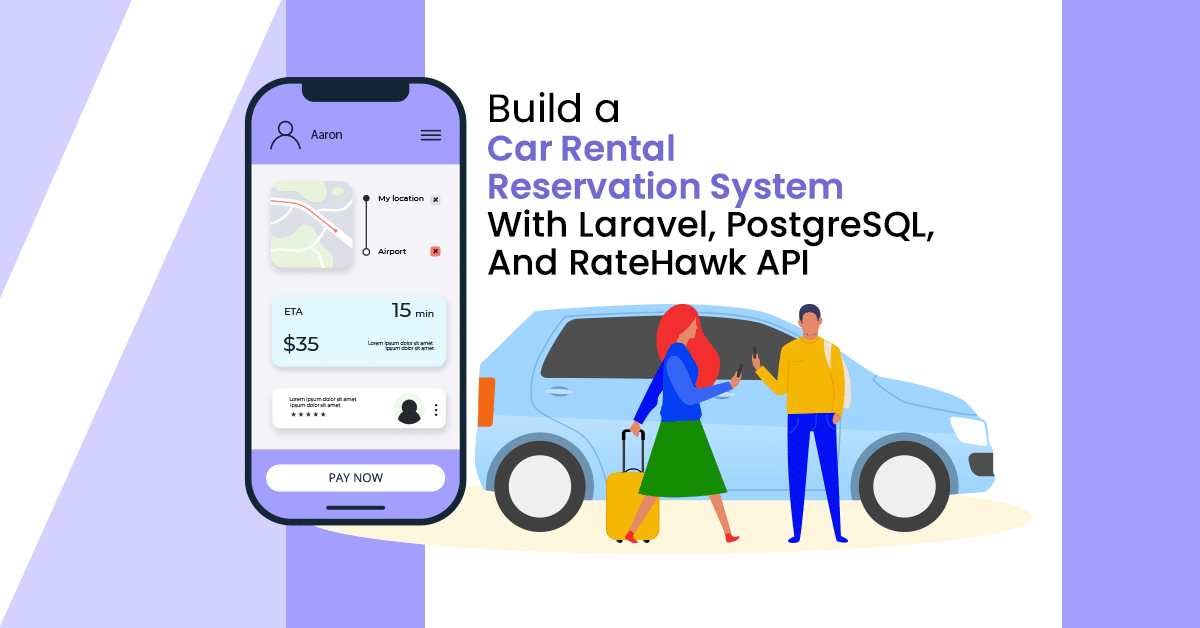
With the rise of the digital-first travel market, customers are demanding that car rental bookings be as simple as ordering a cab or booking a flight. In fact, they are expecting instant results, availability in real time, and secure payments to be done effortlessly in a user-friendly interface.
It takes such a platform to allow a user to proceed effortlessly. The fusion of Laravel, PostgreSQL, and the RateHawk API is an excellent platform to achieve that phrasing. The mentioned stack is what developers and businesses can use to make scalable car rental systems that are not only technologically sound but also secure and sustainable.
Why Modern Car Rental Platforms Need Smarter Systems
Conventional car rental methods are usually dependent on old structures and search options that are limited, slow to process, and require annual data updating. These problems annoy users and stunt growth.

The use of modern web frameworks and APIs completely changes the game. By combining Laravel and PostgreSQL with travel APIs such as RateHawk API, companies can develop platforms that:
- Indicate the availability of cars and prices in real time.
- Make vehicle choosing and booking easier.
- Allow secure online payments to be done without any problem.
- Keeping booking data that is well-planned and easily accessible.
Such a move converts the static rental platform that was there into a linked, interactive ecosystem.
Contact Us Today
Step-by-Step: Building the Foundation
What follows is a brief rundown of the architecture of a system that implements this idea—the aim of which was to explain the overall concept rather than giving detailed code, for the benefit of readers without a technical background.
Step 1: Define the Booking Flow
A clear booking flow is essential. The system should guide users from search to payment without confusion.

Here’s how the flow generally works:
- Users search for available cars based on location and dates.
- The system fetches real-time results from the database and external APIs.
- Customers review prices, models, and features.
- The reservation is confirmed instantly upon payment.
Each step is under the close watch of Laravel, which is the central controller and communication with both the front end and the database is maintained.
Step 2: Use PostgreSQL for Reliable Data Management
When dealing with platforms that have several vehicles, customers, and bookings, the way data is organized becomes very important.

To manage:
- The database of cars, their details, and their condition.
- The user accounts and history of reservations.
- The pricing policies and availability are based on locations.
PostgreSQL provides excellent performance and stability, which makes it a perfect match. Its feature of handling complex queries in an efficient manner is the main reason why users get to see up-to-the-minute data that is always accurate.
Step 3: Integrate RateHawk API for Travel Connectivity
Though RateHawk is generally associated with hotel data, its API can be used in a creative way to work with travel platforms that have a wider scope.

If you link your car rental platform to the RateHawk API, you will be able to:
- Present combined offers with multiple services (car + hotel + transfer).
- Show the availability and the price in real time.
- Make booking confirmation the most secure way for every service.
Such a coupling of technologies is a perfect solution to the problem of how to go from car rentals to the rest of travel planning. The travelers will then be able to take care of their trip in one uninterrupted session.
Step 4: Focus on the User Experience
Design and usability through and through have the power to influence the customer to finish their transactions.

A few essentials are:
- The least number of forms and user-friendly navigation.
- Device-friendly designs for quick and easy access to the service wherever the user is.
- Convenient filters for vehicle category, cost, and place of collection.
- Immediate confirmations to create confidence in the users.
Besides, a neat and responsive design will not only lead to an increase in the conversion rate, but it will also be beneficial for the development of user loyalty.
Step 5: Enable Secure and Fast Payments
Generally, payments must be very simple and straightforward without any difficulties, complications, or confusion. A platform that allows payments via different gateways like PayPal and Stripe, as well as locally available wallet options, is the most efficient way to win the trust and provide ease of use to the customers.

Theoretically, the platform should also be automated in every aspect, like the notifications, booking confirmations, payment receipts, and reminders, which will undoubtedly maintain a good rapport of trust and security with your users at every step.
Book your Free Consultation Today
How RateHawk Strengthens the Travel Experience
The RateHawk API is essentially the tool that opens the door to anytime, anywhere carriage rentals with various travel services. Thus, envision a customer ordering a hotel through RateHawk and, at that moment, finding the closest car rental options, practically in the same portal.
This fusion:
- Supports the linking of bookings between different services.
- Feet of customers in search are less tiring.
- Can be monetized, thus by way of bundled offerings.
The combination of such front-end interfaces with sturdy backends like Laravel and PostgreSQL is what ultimately delivers the kind of travel that is without hitches, swift, and strongly linked.
Expanding Beyond Car Rentals
When the base is set, you can connect your platform to different vertical flights, hotels, or even curated travel experiences without much hassle.
As Laravel is modular, you can gradually add new APIs or payment systems with less and less work. The identical framework that is used for car rentals can be a means to a comprehensive travel ecosystem in the future.
Final Thoughts
Constructing a vehicle rental booking system with Laravel, PostgreSQL, and RateHawk API goes beyond coding; it’s the invention of excellent travel experiences.
Such a triad guarantees a great future for developers, ease of use for customers, and robustness for enterprises. Hence, it is possible by considerate coupling to offer a tool that is not only made of efficient workflows but also still open to the subsequent wave of web travel.